

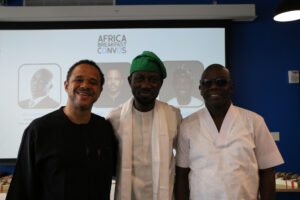
Speakers: Sam Onyemelukwe, Senior Vice President of Global Business Development, TRACE, and Ayo Animashaun, Founder & CEO at Smooth Promotions, Hip TV, & The Headies.
Moderator : Ayeni Adekunle, Founder and CEO, BHM
Ayeni Adekunle:
Good morning everyone! Thank you all for sharing! It’s wonderful to see such a diverse group. I’d like to now introduce our panelists for the next discussion. I’ve got a job to moderate the conversation between two people that I have a huge history with. I’ll call them on stage. The first person, if you still hear, is a gentleman called Ayo Animashaun. He’s the founder of Smooth Promotions, which owns one of my favorite television channels on the continent, and it’s also the founder of the Headies Awards from the Hip Hop World Awards, which is the foremost and leading music pop culture. I’m going to introduce his competition. You’ve got a choice. Today, I’ve got both of you. I’m going to introduce his competition, his good friend – Sam Onyemelukwe. Two gentlemen who have played such a tremendous role in the development of the industry on the continent. I think the platforms that they own and that they run. Along with similar platforms of some people in this room and those not here today. Role to play and I’m just going to start by asking. What do you think is going to happen in the next 1020 years to Africa as a continent from the point of view of the rule that our music, our fashion, and our film plays? What’s your prognosis? So to speak. What’s your prediction? What do you think is going to happen?
Ayo Animashaun:
Thank you for having me. It’s a big privilege to be here, you know and to answer your question. Where we are now, if you remember where we’re coming from, you would not believe we’re gonna be here today. There were years, you know, we all wanted to just be on Nigerian television, nowhere in the world, and in fact, I’ll give you a short story, you know, to start this. When I started my career, by the way, I’ve never worked for anybody. When I started publishing, I thought I was doing well and I wanted to get married and meet my in-laws. The only question my father-in-law asked me was just Mister Man, what do you do for a living? I brought out the publication that was being published at that time. He proposed a magazine, you know, and he was like, I don’t know I mean your job. It Didn’t look like a job. You know, coming from and you can say that to like about I speak to some of the guys that you know, people brought their kids back in to say you have to go to school, not listen to music. Now parents are building studios in their homes for their kids. Same thing with footballers. Send them out. Go and play football and they put it as part of their daily routine to play football and they take them to football pitches to go and play football. This thing used to happen, so coming from where we are coming from, seeing what was where we grew up with and how we got here. You can. I just can’t imagine where we’re going. I believe that if you continue this way, we’re gonna take over the world. We can say we are doing that already, but not even enough we are. Music is being played all over the world. We are selling out concerts and shows and everything, but I think the next part will be what the movie industry is already doing, telling our own stories without music. Because if we listen to the content of our music now. You won’t find our stories every day. You don’t. Yes, you find our lingo there. You find our lingo there, you know, and that’s all you don’t. You don’t see our stories there, and I can’t speak to why that is the case, but we are not telling our stories without music.
Ayeni Adekunle:
I’m going to stay with you before I come to Sam. The role that American pop culture as an example played on your business, your magazine, Hip Hop World magazine, was the source, right was all of that. That’s a big influence. We call ourselves people who have never been to New York. I mean, we knew the East Coast and West Coast and loved that there was a huge impact of Hollywood and music and all of that on how we grew up and on how it turned out. What role do you think? Music, for example, pop music or band culture from Africa is going to play. In helping us transform the continent positively in a sustainable way. What do you think we need to be thinking about to start to stop or to continue? OK.
Ayo Animashaun:
Now it is not in our music, but there has to be something that people like us are doing and people like Sam are doing and how we need to tell our stories and encourage the artist to make music. That will reflect this. I mean, if you listen to for example. The guys that didn’t know that could not pronounce Ojuelegba, you know, they were telling and we need more of those to tell our stories to the world.
Ayeni Adekunle:
Thank you. Now, Sam. Trace, Channel O, Hiptv, Soundcity. You’ve been at the center. What about today, has become Afrobeats? I mean push right across. Even where we are now, OK. What challenges do you see facing the musician, the entrepreneur, and the entire creative ecosystem across the value chain? What challenges? What barriers do you see? And that needs to be addressed for us to be able to build this global platform that can sort of, you know, help Africa lead. Are building what barriers? What challenges do you see that need to be addressed?
Sam:
So I’m gonna go back to the first question you said because you just said one thing that I thought was critical about where we’re gonna be in 10 and 20 years and to bring everything full circle. I was at a panel yesterday where Alex was moderating and he asked what I thought was the most important question, which was in 20 years. What? Please. He was not disparaging African culture or music. What he said, what if in 20 years we find out that this was just a trend? Right. Yeah, this was just a trend, right? And so it goes to the very root of the question that you’re asking, which is that to me, the biggest thing that needs to happen in the music industry. In soft terms, everybody in the music industry should be able to earn a respectable and sustainable living, even if they don’t end up as the next big superstar, right? Even if they don’t end up as A you know the whole list of them, right? From studio musicians to, you know, performing musicians to those writing for TV shows, etc. Until we can reach into the music industry specifically, I’m not talking wider in the creative industry until we can reach that level right then we’re just chasing the next big track, right? Here in the States or the West in general, even if you’re not A. So the biggest hit artist can still make $100,000 a year on your royalties from writing a song from having you know whatever you work in a studio, whatever it is, a respectable living. We’re far from that for many reasons that we all know on the continent, right? So do those protections around intellectual property. You know, the ability to collect the money from performance, rights, royalties, etc. Those are the fundamental things, specifically in the music industry that need to get into place.
Ayeni Adekunle:
OK, I want to talk about money. I’ll come to you. So there’s a lot of money in this room and we will be doing ourselves injustice if we don’t sort of bring it together. Something you say, Sam, if I’ve been able to monetize. You know, I started my career at a point where they were low. Train the artist, who, 10 years down the line, could not even pay their bills. What opportunities do you see? Given where Africa is now, and given the problems that companies like a further wave and pay Stag, and then you spoke about, I did talents and so on to base here and spoke about mobile money and all the pills. What do you see? In the next couple of years, from the point of view of being able to 1 build platforms for Africa or globally think Netflix. I think Amazon and so on, but also to be able to monetize locally the 1.3 billion people on the continent. What trends are you seeing? What are you thinking?
Ayo Animashaun:
Thank you. If you check my job very well, there are not enough studios. They’re not even business students. They’re not building infrastructures for the artist, so. They can be put together. You see a lot of talented artists when you call a talent show, you see thousands and thousands of them there to win 100,000 thousand naira to 1 million Naira. By the way, $600. Now you know, 2 million, 5 million and they don’t think that would change their career. They’re not even talking about cars anymore. And guess what they want to do with the money? They want to be able to make music and shoot the least of qualities when it comes to videos. Now what they’re doing, how do you monetize these videos? See the data platforms that provided us with a huge opportunity to monetize our videos.
There’s the YouTube monetization subscription and everything, and you also see the streaming platforms and they’re able to monetize on the streaming platforms. 10-15 years ago, 20 years ago, it was Alaba and you would produce your CDs. You know they’ll give you money to produce your CDs, produce 50,000 copies, and tell you that you know, for you to sell and produce 500,000 copies for themselves. Now that does not exist anymore because there is the digital. Media infrastructure, which, by the way, can you know, arrest copyright. There’s also one once you’re able, and there’s also when you open your YouTube now. Artists are beginning to, you know, do sponsored posts, you know, of their videos. You know, one side of it is just to end more revenue to be more visible, you know, and when these trends continue, all the platforms, it’s like you can’t stop them anymore, you put it.
They put it on as long as the music is good, somebody sees it and somebody can see it anyway and say, you know what? I want to invest here. I was speaking with one record. I was looking for one to call a Liberal executive, one of the top ones that got funding and it was telling me how they got funding. They were just putting out music, putting out music, and one of the biggest record companies from this side, you know, saw what? They were reading out to them. They didn’t even have structures and say, you know what, you’re not. Don’t worry, you’re not going to invest our papers and books are no good. I said, don’t worry, we’re going to fix what is not good. But we like what you’re putting out there. As long as there’s this globalization now and the world is becoming smaller, you put it there. Someone is saying view on YouTube. The content here is going to be on anybody in the world who can see and that is just going to be very, very big for people that actually can create music or just show that you are talented in any way, form, or manner.
Ayeni Adekunle:
Thank you. I have one more question before I put it back on the spot, but I just want to ask. He spoke about the move without speaking about the movement deal. Yeah. So my question to you is which was good to see and which was deserving of that kind of organisation. Do you expect more deals like that if you look at your organisation?
Sam:
The reason why I believe we’re not having enough is that a lot of guys are not, you know, really, really doing what they should be doing, you know, to attract the right investors into their music projects and I can say for the fact that it’s not just even in Music is across the creative spectrum Some guys have tried. I see someone who is a friend of mine in Dubai and what it does is it makes clothes. It got a deal with one of the major labels to make African attire and they claim millions and millions of dollars in the companies. Are we doing enough? You see, some guys who are so creative in their way, but they’re just doing it with, you know, on their own. And they’re not out there. So whatever manner and form we can pull away within our depth, structuring our business in such a way that we attract the guys ’cause you know Africa like I say like people say, the new frontier people are looking to invest in Africa, but Africa has to be ready. We are ready, but we have to provide ourselves with, you know. Why the guys? I want to put money in, you know, in Africa the right. That’s the right environment to be able to do so.
Ayeni:
Tell us a bit about the story of Trace and how you are sort of playing in this space across the continent, what value you are adding and how the complexities on the continent that affect the planet spoke about the business environment. Regulation and all of that and the opportunity that you see from the trace point of view. What you’re doing, what challenges you’re experiencing, what opportunities do you see 100%, and what we might be able to learn from how you are navigating the continent at this point?
Sam:
Number one, I have been with Trace now for 13 years and when I started outside of the company, I started with my own business. As an agent for Trace at this time I represented Fab Magazine, Warner, and Google at the time and ultimately I worked specifically with Trace. They bought my company and I joined as part of the management and a shareholder within the company. Trace is just over 20 years old now. We are operating in 12 countries with office operations on the ground in 12 countries across Africa, a little bit in Europe, the Caribbean, and Brazil. We are owned by a private equity firm about 80% by an American private equity firm.
But their growth fund, right and truthfully, we’ve been with that company now and getting ready for the next iteration of the business. So in the coming year, and a half will be exiting that, and going through another financial transaction, raising money, etc, and to that exact point, we’re hopeful that the bulk of that can come from a mix of on the continent and from The US. Without being, you know, whatever it is from black and brown creators, and that is or People that are involved or allied with the media space. But that said, it’s very difficult because right now I think of it for eye on eye in traditional media. Where we’re from, It’s not an exciting growth industry. If anything, traditional media is being looked at as in, oh, you know, it’s slowing down.
We have our challenges when it comes to pay TV or cable and how a lot of our business is distributed, you know, so it’s what they say, what we hear in the industry or what the trends are in the industry is that even. Doing traditional media, or at least media, you know, TV channels which will transition too fast. Sorry if I get a bit complicated. Fast channels or YouTube or whatever it is that at least there must be some tech overlay or some tech and that makes sense, right? We’re already trying to be digital. It has done much better than we have in terms of its presence on social media. The generation of content and that’s at the root of what we do right. So, our biggest problem is Trace.
We have 9 offices on the concept right and our problem is that each market is individually too small to make an impact on our business right for us to be 100 million or 200 million, a $500 million business. That we do with on the ground in Lagos that you know and the government doing this so we can’t get performance rights etcetera is just around a few $1,000,000. And really, that’s not a scaling business, right? So we look at it as if all of our markets in Africa are just these small fragmented markets where we struggle to scale.
Ayeni:
Let’s open the floor for questions. I want concise contributions regarding the role of media in advancing Africa’s narrative. Let’s take questions from the audience.
Mark:
The music industry has been pretty much dominated by an African narrative that’s centred on Nigeria and South Africa as music is so diverse, and I love it. The range of having representation in different countries and diversity of view of African music. I’m just curious. Where do you see the trend going from more of a pan-African lens to music that includes Francophone Africa And how that can become more of an intentional means of diversifying the narrative of the legends of African music?
Sam:
Well, you know that the crazy thing about music is no matter what music, exact things or the artist thinks, it’s the audience that knows best, right? And I think that we will continue to see, you know, the sheer excitement around Afro beats not the excitement external, the sheer excitement and energy of Afrobeats continue to lead and dominate what’s happening in music. Seen in Africa and I think we’ll see a lot of other regions continue to morph closer and closer, you know, and try and keep their spice in it. So ultimately I see the blends continue to happen and we will start to see more stars from other areas outside of Nigeria as they collaborate and adjust their sounds.
Ayeni:
Thank you for those insights. Thank you for that thoughtful discussion. Let’s conclude here and enjoy lunch. Thank you all for participating!