

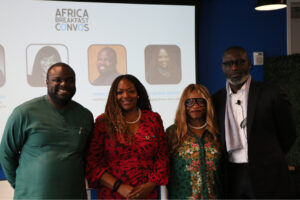
Speakers: Iyin Aboyeji, Founding Partner, Future Africa; Anie Akpe Founder of African Women In Tech (AWIT) and Tobe Okigbo, CCSO MTN Nigeria.
Moderator: Claudine Moore, Managing Director, Africa, Allison
Annie:
Hi, my name is Annie Akpe, I am the founder of African Women In Tech (AWIT) which was launched in 2016. I’m based in New York and even before then we were doing events in New York City, I was training entrepreneurs. My background is actually in banking, so for 17 years I was in banking, and from banking I said, you know what, it’s time to do something else. So that’s where African women in tech came into play, we started in 2016. From there, we have been to Nigeria, Mozambique, Ghana, Kenya, and also Uganda. We are building a new platform and I look forward to sharing more about it with you.
Iyin:
My name is Iyin Aboyeji. Everyone calls me E. I’m the founding partner of the Font for Africa’s Future.
Most people call it Future Africa. We serve entrepreneurs on the continent and those who are turning Africa’s biggest challenges into global businesses. Specifically, we provide them with capital coaching and community. We’ve been very privileged to be a part of many of the huge success stories out of the continents in particular, 2-3 out of the continents, 7 unicorns.
Where I was, I had the privilege of being part of the founding team of ANDELA, which is a talent accelerator that helps take talented young people and skill them into global technology companies. I also had the privilege of being the founding CEO of Flutterwave, the continent’s largest Unicorn by valuation, which helps manage payments across multiple different countries and payment types. Finally, I was one of the founding investors in Move, which is the continent’s largest mobility fintech company, which is backed by Uber and Mubadala.
Tobe:
I am Tobe Okigbo, I’m a lawyer. I work for MTN. As a rule, I don’t come out in public, so kudos to Ayeni. Two days they’ve gotten me to come out in public. I prefer to stay behind and get the job done. It’s my privilege to be here. Thank you.
Claudine Moore:
As we engage, remember that it’s about connecting and networking. Let’s dive into our first panel discussion on technology and finance. The first question and the question is open to everybody in the panel, but maybe Iyin this might be good for you to start with. How is the African fintech ecosystem evolving and what unique opportunities do you see for businesses in this space?
Iyin:
Thank you very much for that question. So I think first of all, what is very clear to anybody who’s avidly watching this space is. The early days of what I call layer one Fintech technology is over. So you know, if you have any friend who’s thinking of starting another payments company, if you love them enough, you can tell them the truth, that there’s probably no point. Well, you’re doing something different. I’ll get to that. But for the most part, if you’re just trying to start another generic payments company, it’s probably not worth the additional effort because a lot of that technology has been commoditized over the last, you know, five to seven years. What is now going on is that people who are very focused on particular workflows, who are focused on integrating payments into particular workflows or experiences are they the ones who now are coming to the surface? I like to call them layer two technologies, so they’re not just broad-based payments for everybody.
They’re very specific about what and who they’re performing payments for. But the bigger opportunity in my mind, because I like to be one step ahead of the market because that’s the only way you can lead them, is the opportunity to take a different kind of look at some major flows that come into the continent and better organize and orchestrate those flows so they can deliver impact on the ground to Africa as a whole, close to $70 to $80 billion a year, which is far more than most official development assistance to the continent and you know, even though the US likes to pretend like they’re the biggest aid funders to Africa or anywhere else, Don Diaspora do far more than that and for a long time. Maybe it honestly has been How do we lower the cost of these inefficiently delivered remittances, not how do we organize these remittances to deliver impact on the ground in more sustainable ways through investment and through? Impact.
Now you know there’s a bunch of creative young people who are saying, you know what, like rather than have a conversation about how we can make inefficient remittances. More left, more costly and more and you know more easier to do. Why don’t we think about how we can aggregate and deploy remittances as capital into the continent? Africans probably spend 20 to 40% of their income sending money home and they get nothing for it. That’s simply because of how they do it, right? So they’re mostly sending money straight from their paycheck and paying Uncle Sam for that privilege. Meanwhile, if they worked with the foundation, not only would they be able to aggregate those sums and establish sustainable infrastructure on the ground that can subsidize those remittances, but they would get a tax credit for the benefit. Another big one is in terms of investment on the continent and one of the incredible things is thinking about at a structural level. How do we make it easier for the African diaspora and people who are doing business in Africa to be able to do it from anywhere in the world and the tons of Nigerians who set up shop in Delaware and have never been anywhere near the U.S. embassy?
There’s no reason why people cannot set up business in Nigeria and not have to ever visit Nigeria. That’s why one of the things we came to start the UN this year was to launch Nigeria’s first digital economic zone, which essentially allows you to set up a company in Nigeria and operate as a global business. From anywhere in the world, you get incorporation bank account payments, you get the ability to if you. If you have employees you want to bring in or you don’t have a US visa, you want a Nigerian visa. We can facilitate that for you. We can get you a work permit and any other regulatory license you require or also in a tax-efficient way where you don’t have to pay any taxes. So this is where Fintech is going, which is how do you better orchestrate investments? How do you better orchestrate impact on the continent as opposed to how do you make it? $100 moves faster from New York to Lagos.
Claudine Moore:
Yeah, I have a question in line with that for Tobe. What role can telecom companies play in advancing financial inclusion through mobile money and digital payments?
Tobe:
I think about this actually with the story of MSI, some of the early days of GSM in Nigeria. One of the easiest ways to spend money is also something that we did at the group MSR. I don’t know how many of you remember that you bought 1500 Naira MTN, which I’ll send to students. The students sell it at a discount of 1100. Mobile money is not that smart of a thing. It has moved. There’s still opportunity. The chances are that if you scale, you can drive it. Something strange going on in Nigeria now is that despite having that ability. The space is moving on without waiting for the mobile companies or companies and this is because, like I said, a lot of the POS is the point of sales and all that. If you go to Nigeria now, banks used to power the banks and now the POS is taking over. We’re hoping that they don’t feel the need to have that, so we can then introduce a QR code. Take it down to the last minute, the very last present. There are challenges, the challenge being devices, and the device ecosystem. Devices are not available that can do a lot of the things you like to do. I think we have a 7:00 or so percent gap in that space. I’m not communicating with all the people in the rural areas, and cannot participate using PR rules and all that. I think the bigger challenge is the devices. We’ve had our license, mobile, and our PSA license now for 20 years.
We still haven’t got to shoot, Glo and 9Mobile telephone company in Nigeria got before us. They haven’t, as far as we have with everything we’ve done, we still have not been able to crack, to break and crack into and get to their MPs in Kenya. For those of you who have been going to Nairobi, you don’t need anything you don’t need. Your mobile phone. I can look after anything you want. What has been made the major if you say a couple of challenges in scaling that? We handled it five times. We have. OK, it’s one thing. Another thing is trying to assure people in that space that what we’re trying to do is bring everybody on board. You know, like they say kind of music mobile operators coming into that space. We feel that we can bring everybody in and everybody from moment to moment to see what is going on and then that will improve access and all that to the bank having more clients. If you look at the kind of life science we have it might be doing more of a problem with you. I have the numbers but I have problems and those problems because I’m a huge organization. They’re trying to fund a huge tax on their run on this game. Fix it. The problem is how will I work with these people. So that when that trade is fully built in the fintech space, for example, they can come in and do what they need to do to scale it and create value. For everyone, I think, well, is it? We still have a role to play.
Claudine Moore:
Thank you, This is a question for everybody, but maybe starting with you, Annie.
Working across the continent challenges opportunities. How much of it are you doing? What patterns are you seeing and doing? What can work? What doesn’t work? What challenges are, and what opportunities there are?
Annie:
Kind of funny because I came into the market different from everyone else. So the way I came into the market was through training and educating young women and girls and the way that we did that was we worked with universities and co-working spaces. We work with the community. So anyone that has a community organization, we reach out to, so imagine you’re doing this in Kenya, you’re now doing it in Uganda. You’re now doing it in Ghana. So we already had a built-in community. So for people that are coming through African women in technology, you’re funneling through our channels.
So you already have a built-in community that you’re connecting with and with that community you have executives, you have students. It’s varied. Varied in terms of the demographics within that community. But for others, as you’re moving through different countries. So even for me, I’m Nigerian and I’m still trying to do business in Nigeria. It’s always been a challenge. I don’t think I’ll ever get it right, I bet. The people have tormented me so much, I said. I’ll just avoid you people. Small, but some of the challenges included, just like logistics. Thinking about resources, you know where you’re going to train people. Where you were going to do initiatives that would make a certain impact, Nigeria is huge.
So it was just a matter of where we landed. I found that Uganda was a lot easier business-wise because the people were more open. I find that Kenya is like an open-door policy. Everybody can walk in and you can set up any business that you want. It’s 10 times easier. I mean, some of the things you mentioned earlier, such as the business setup are priceless for people because some of your challenges are initially just setting up the business. Who to talk to? To fill out some countries is a lot easier than others. I found Ghana to be flexible as well. I think that it’s just a matter of researching what country you want to go to, but if anyone were to ask me, I’d be kind of selfish in the sense of saying Kenya because Kenya has helped a lot of the businesses that I’ve worked with. To make movements in that area, I think that some of the laws are USA-friendly.
If you’re used to some of those laws and know how you can navigate in that space, the challenge is just not knowing. The space not knowing the context, not having the right people. So I think he mentioned the business that you set up in helping other people set up businesses. That’s the way to go, I think. When you’re trying to do it on your own, you have to do a lot more research than you know what is commonly known to do. We do research here in the US, but as you transition to another country, that information is not so easily available, people are not so helpful and everyone is not a friendly face. So always proceed with caution and make sure you use the correct information. From people that you know and trust, such as Iyin who’s developing a platform similar to that. So yeah, some of the challenges we face with that. What I like to say about Nigeria is that diamonds are only found deep in the ground and you gotta sweat to get it and the truth is, I’m a big fan of Lagos. You know, Lagos made me a billionaire and I will always insist that you get all the flavor of Africa from Lagos. You know what you want. There’s a Nairobi side of Lagos. There’s a Uganda side of Lagos. Over the Shooky side of Lagos, there’s the ocean side of Lagos. You know, whatever you’re looking for, you find it in Lagos because it’s just such a diverse place. But again, it’s not for the faint of heart and you really gotta be very discerning to get the value from the relationships.
Again, we’re trying to abstract all of that because we think it doesn’t make sense. You know, I try to help as many people as I can, but I still only have 24 hours a day, so I have to figure out how to tell myself about a product or AI so that I can help as many people as I can. That’s the idea with the companies we build. But I would say my biggest thing is. If you want to scale across a continent, declare what you’re looking for. Understand what you want. If what you’re looking for is a big billion-dollar business, you want to start in Lagos with all these challenges and struggles and all of that and hopefully, those challenges keep you focused on why you’re there because you know it just makes sense if you’re looking for why. Would you stay? I mean, apart from the fact that you’re from Lagos, why would you say start in Lagos for those in the audience who, like, want to know? Why? Well, well, Lagos within Lagos has the highest density per capita when it comes to returns. So within an area that is probably not larger than Wall Street, right? You’re probably sitting on $70 to $100 billion just from equity to the second gate of Lekki phase one, right? And the question is, look how quickly you can get through that morass. Because it’s right there, all the values right there, there’s another one down the street from him that they probably built IHS.
There are like 10 banks. Four or five of them are billion-dollar revenue. I’m not talking about valuation.
I’m talking about $4 or $5 billion revenue companies. So if you’re, if you wanna, if you really wanna get to scale. You should just go to Lagos, but I know that’s not everybody’s company. Right. Sometimes people just want to be able to run a business that they can understand and they can wrap their heads around and that’s why I say OK. You know, if that’s what you want, then you know you can work with Kenya. I think Kenya is a great market to be in. I think Uganda offers a different flavor. I think Cape Town or Johannesburg also works, but my experience has been, you know, Lagos, everything that can go wrong will go wrong. And that’s great for you because now you have the full range of possibilities And no problem is new as you scale across the continent, everything looks like something you’ve seen before and that has been my own experience because it’s just so tough. It’s like going to the gym so you can win the finals, right? So you, you sweat it out in Lagos, and now our job. We’re trying to make it easier. That’s the idea of getting Lagos State. I engage Lagos State a lot because I think states are more powerful than federal governments. About Nigeria, Abuja can’t do anything for you. Work with the state government so states are more powerful than federal governments. I think that you have to be very micro and hyper-focused in the kind of relationships you want to build. Some people have the credibility to help you and there are people who if you reference check will find out what you need you just need to be very focused on what you want and deeply understand the opportunity that you’re going after. Whether it’s profit or impact. Or both. Is it possible? Profit is impact. Profit is impact. The impact is impact, right?
Claudine Moore:
OK, very profound. That, somebody needs to tweet that. Please. For us, we don’t have a hashtag, but someone should tweet that, OK?
Tobe:
If you look at every language as a tribe, you’re looking at every tribe as a nation. So you’re looking at cultural differences across the entire Nigeria and then like you said, also states are very powerful. Local governments are very powerful. You have 774 local governments. You have 36 States and Abuja, which is a state. So if you’re operating an organization like we do, that is in every local company, you’re dealing with different issues culturally, sometimes legally, and from multiple regulations is an issue for the telecom industry. We have 149 taxes that we have to pay or compensate for. If you look at that operating environment and exclude that like you said. If you succeed and the rest of Africa becomes improved, what are the challenges with Africa? No, this is one of the states where if I started going to Kenya, this Kenya with London. I’ll get to London faster. We should change. If you look at what you have done, if you look at the European Union and you look at the regulatory environment, once you understand it, you can do business only right in Africa. You’re OK with every country. Not different problems in 19 countries in Africa and sometimes events because what works here may not work. The level of engagement you need to do to get regulatory authorities to listen to you is the licensing regime. Sometimes it is so far apart that you’re confused as to what is going on. So Africa is off. But like you said if you want to get them to. So the Africa Free Trade Agreement, everybody’s waiting and hoping that we get it right and it will help our cause confidence. Another thing is that we have experienced people who have been there, and done that since, and I like to always say that Nigeria wants to work. They are working to work.
You come to Nigeria, the opportunities are there, the foreign company, you make a lot of money. Take over the news. How many become over? This consoles what one hopes is that the more we talk about it, the more the people who are in authority will listen. As I said, people will give me a billion-dollar problem and I’ll give you a billion-dollar solution. He’s sitting on that one. Right. Talking about sitting down and saying, OK, that’s great. Did these guys get this right? And I’m going to sit down in New York and set up a business in Lagos and run that business. It’s a nightmare to call my grandma to do your homework. And what if you can do it and do it there and get it right? To deal with anything the government can do. However, whenever you set up a government. You just have it. If you don’t get it right. So the promise of Africa will not affect your rights. Listen, we’ll agree here. Everything remains the way it is with the government in Africa. Believe you me, 10 years from now, when you say, oh, ten years ago you said that because if you look at the continent you find out that most of the suffering is despite not because of and that’s the key thing. It’s despite it. So because of everything the government is in England rather than an enabler. That’s what needs to change. And unfortunately, if I cross most of the country.
There are good countries that are trying to get devices like one that can. For Example, if you don’t let go of a room, you don’t do anything, then you will understand that when everything is said and done, you just have to find a way to create the environment because they say 25% median age is the next continent of the future And all that we will be creating a nightmare for the rest of the world. We will and it’s funny. I was at the Future Summit yesterday at the UN and it did feel very much like there were lots of presidents speaking. It did feel very much like it. This is probably my 15th UNGA, you know, it’s the same kind of conversation but what? What does seem to be sort of shifting and I saw the shift last year continuing this year is the conversation around investing and I’d like us to shift a bit.
Claudine Moore:
Did you have a comment, Annie, about what Tobe was saying before we shifted to investing and before Annie speaks? If anybody from the audience, If You Have any questions, feel free to raise your hand.
Annie:
The question that I mean the comment that I wanted to bring up was also talent. Yes. When we go into the spaces, that’s one of the things that has to be looked at. As I mentioned, Kenya is easier and everyone said yes, Kenya is easier. That’s correct. Going to Kenya is easier. Nigeria is like New York. You have to hustle if you’re not hustling, sit down. You won’t make it. But we made it work. We’ll always make it work because that’s just who I am. However, it was a challenge that I’m telling you, you know, no carry last. You know how we do, but just know that that is the situation and don’t go into it.
The other thing I wanted to mention was language. We hosted things in Mozambique and one of the things that we had to teach some of the young. Women were just pitching because they were pitching in Portuguese. The investors are English, you know, and we had to do a lot of translation and that was some of the barriers that we had to go through. Just the communication. So language and also talent take time to train. I just think that it’s expected that you should know that if you’re going to go into a market and your structure, the way you work is different. Corporate America does not exist in Nigeria, yet we go into it with the thought that this is the way things should be. There are standards that you have for your organization, but it is for you to understand that that type of talent may not always necessarily be there and be prepared for that type of challenge as well.
Claudine Moore:
Thank you all for your insights. Let’s give a round of applause for our panelists! Please help yourselves with breakfast and refreshments. We’ll also take a group photograph now, so feel free to chat and network while you enjoy the snacks. We’ll be back shortly for the next session. Thank you!